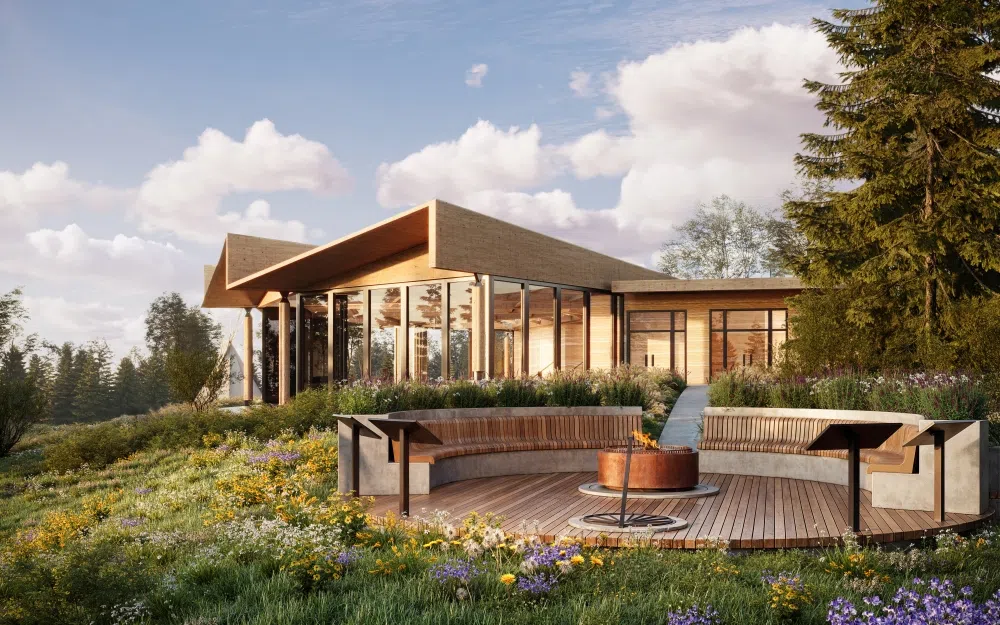
The Manitou Stone is being moved to Elk Island National Park and will be under the care, custody, and stewardship of Indigenous People. Render from the Tawaw Architecture Collective Inc.
Many years ago, a 145 kg iron meteorite fell from the sky, and became a sacred stone to Indigenous people in Alberta.
The Manitou Stone, also known as Manitou Asinîy (which means Creator’s Stone), awâsis kôhtakocihk kîsikohk (the child fell from the sky), the Iron Stone, the Iron Creek Meteorite, and the Shining Rock, fell on an unknown date, many years ago.
The precise location of where it fell is unknown, but it is believed to have been near Hardisty, Alberta.
Over the centuries, the meteorite became so embedded in Indigenous spirituality and venerated by the First Nations people, that it became a protected site amongst them.
Manitou Asinîy is known as a healing stone and is credited with protecting buffalo herds on the northern plains, and people visited Manitou Asinîy to leave offerings, pray, and hold ceremonies.
At the time, Indigenous people agreed to protect the area, and keep Manitou Asinîy safe.
Which they were able to do until 1866.
It was at time that Manitou Asinîy was stolen from the land by a Methodist missionary, known as Reverend George McDougall.
Reverend McDougall saw how significant Manitou Asinîy was to Indigenous people, and he thought taking the stone to the mission would draw Indigenous people to Christianity.
Once Manitou Asinîy was taken, it was prophesied by Indigenous spiritual leaders at the time that war, plague, and famine would soon devastate their people.
Years after Manitou Asinîy was removed from its site near Hardisty, Alberta, missionaries sent Manitou Asinîy to Victoria Methodist College in Cobourg, Ontario, which is now part of the University of Toronto, and was on display at the Royal Ontario Museum for years.
Then, at the request from the Alberta Government, Victoria University College placed Manitou Asinîy on long-term loan with the Royal Alberta Museum (called the Provincial Museum of Alberta at the time) in 1972.
In 2001, Victoria University transferred the title of Manitou Asinîy to the Royal Alberta Museum, with the understanding that museum staff consult with Indigenous nations who have a connection to Manitou Asinîy.
Recently, the Manitou Asinîy-Iniskim-Tsa Xani Center, which is a not-for-profit organization, had been conducting consultations with Indigenous communities, Elders, and knowledge holders to create a consensus on where they would like Manitou Asinîy to be located.
A member of the Board of Directors of the Manitou Stone Foundation, describes how he first heard of the Manitou Asinîy.
According to this member with the Manitou Stone Foundation, when he told his son about the Stone, he was encouraged to try and get it back.
From there, they started working together to get the Stone back.
Now, they are trying to raise funds for the project.
They are trying to raise $25 million of capital from the Federal Government to build the building that will house Manitou Asinîy, and have asked the Provincial Government to continue with their co-stewardship agreement to continue providing operating funds to the centre, to help protect the stone.
Going back to the prophecy that told of harm coming to Indigenous people if the Stone was moved, this member of the Manitou Stone Foundation explains about what happened to Indigenous people after Manitou Asinîy was taken.
The hope is the Stone will be returned to the land and will be visited by many people.
This member of the Manitou Stone Foundation believes this Stone will become a place of pilgrimage.
According to the Manitou Stone Foundation, this meteorite is roughly 4.6 billion years old and is made of iron.
Once the Stone is moved to Elk Island Nation Park, it will be open for people to visit.
According to Jennifer Duquette, the Field Unit Superintendent for the Northern Prairies Region with Parks Canada, Parks Canada was approached to have the Stone relocated to Elk Island National Park.
Duquette adds that some of the priorities for the Stone were matched well with Elk Island National Park, such as having a connection to bison.
Elk Island National Park is only 47 kilometres from downtown Edmonton, right off Highway 16, making it accessible for many people, which was a priority for the new home for the Stone.
Elk Island National Park began as an Elk Sanctuary, with it being partially fenced at the time.
Then, to help conserve bison, the last remaining bison herd was rounded up and transported by train to the area.
Initially, the bison were meant to be moved someplace else, but that area was not ready to house bison, so they were brought to Elk Island.
And that is where they stayed.
While Manitou Asinîy will be moved, it will be under the care, custody, and stewardship of Indigenous people.
Duquette says they are honoured to support this project.
To enter Elk Island National Park and check out the Stone, people still need to get a National Park Pass.
Currently, they don’t have a timeline of when the new centre that will house Manitou Asinîy will be built, but concept designs have already been created.
The Tawaw Architecture Collective Inc. are the ones designing the building where Manitou Asinîy will be housed at Elk Island National Park.
Wanda Dalla Costa, architect with Tawaw Architecture Collective Inc., talks about the future site of where the building will be built.
Dalla Costa adds that with the location being outside of Edmonton, there is a night sky away from city lights.
The building itself, Della Costa explains, was designed after doing research.
She goes on to explain more about the building.
Della Costa explains how her and Tawaw Architecture Collective Inc. were chosen to design this building.
As an Indigenous architect, Della Costa says it is an honour to be part of this project.
The Minister of Arts, Culture, and Status of Women, Tanya Fir, says the Provincial government recognizes the cultural and spiritual meaning of Manitou Asinîy.
“Repatriation is a key part of Alberta’s reconciliation efforts, and we remain committed to advancing this work in a respectful, collaborative way guided by Indigenous leadership. As the first province in Canada to establish repatriation legislation, Alberta remains a national leader in this work, partnering with Indigenous communities for over two decades to return roughly 2,000 sacred objects to active ceremonial use,” Minister Fir said in a statement. “We recognize the profound cultural and spiritual meaning that the Manitou Stone holds for many Indigenous Peoples and through the renewal of our Co-stewardship Agreement with the Manitou Centre in September 2025, we are reaffirming our commitment to returning the Manitou Stone to Indigenous care.”
Minister Fir goes on to state that while Alberta is proud to be a supportive partner for this project, the decisions regarding the future location of Manitou Asinîy is being led by the Manitou Centre in collaboration with the federal government.
To read the media release about the rematriation of Manitou Asinîy, click here.
To learn more about Manitou Asinîy, click here.
Comments