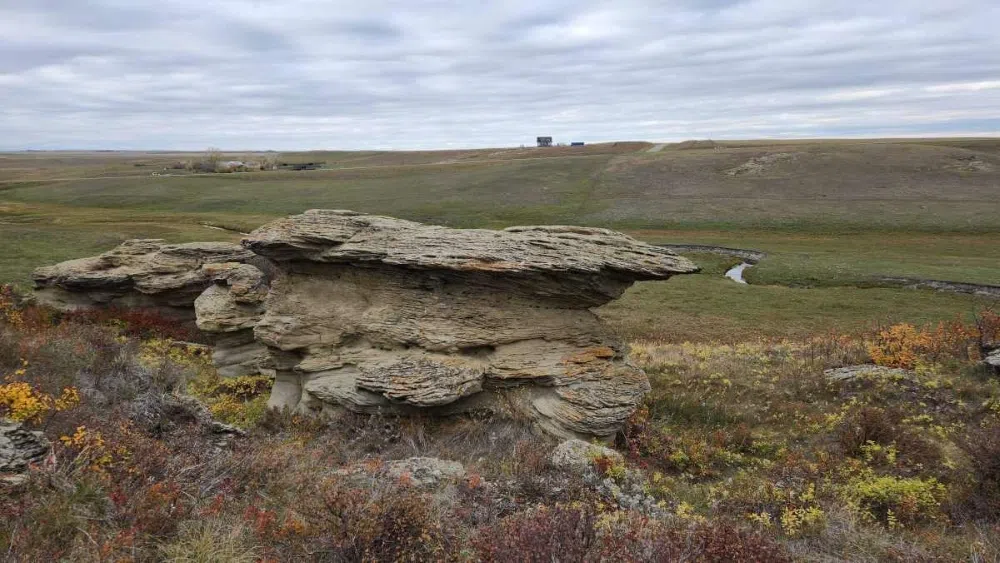
Old Women’s Buffalo Jump sits just south of Calgary, and was used for over 2,000 years. Photo from Parks Canada website
Just south of Calgary sits an historic site that was used for thousands of years by Indigenous people.
The Old Women’s Buffalo Jump National Historic Site of Canada is an historic buffalo jump located in a small coulee near the town of Cayley on the edge of the Alberta foothills.
Jared Tailfeathers, a Blackfoot historian, explains more about this Buffalo Jump.
Tailfeathers adds that there are at least 10 Buffalo Jumps within 50 km of High River.
This Buffalo Jump is referred to as a Women’s Jump, because Tailfeathers says the women and men were living separate for a period of time, and this was the Buffalo Jump the women were using.
This story has been depicted at a different Jump near Stavely.
The way Indigenous People used these types of Jumps involved chasing the Buffalo towards a cliff, which Tailfeathers explains.
While the Old Women’s Buffalo Jump was used for over 2,000 years just outside of present-day Cayley, further south is the Head-Smashed-In Buffalo Jump World Heritage Site, which is now a UNESCO-designated World Heritage Site and preserves over 6,000 years of Plains Buffalo culture.
But, as Tailfeathers explains, these Jumps were all over southern Alberta.
Tailfeathers says the reason why there are so many Buffalo Jumps and historic paintings in the area is due to this area being a huge part of Blackfoot life.
Tailfeathers adds that all over Porcupine Hills are paintings that are roughly 1,500 to 2,000 years old.
According to Tailfeathers, the reason why these cliffs were used to help kill Buffalo, is because they learned from wolves.
While that method was used to kill Buffalo, the people would only herd off only the number of Buffalo that was needed, and do it only when needed, so they wouldn’t overuse resources.
At the site itself, there are also a couple caves.
Old Women’s Buffalo Jump is the English name of the site, but Tailfeathers tells us what the Blackfoot name for the site is.
Tailfeathers explains how people can find this Buffalo Jump to check it out.
This Buffalo Jump was rediscovered, thanks to some extreme weather.
With that, Tailfeathers says that a lot of old Indigenous sites were damaged due people shooting at them or not taking care of them properly.
Even though this site has not been used sine the 1800’s, Tailfeathers says there are still Buffalo bones on site, but because it is a Historic Site, people aren’t able to bring the bones home.
Tailfeathers adds that there are numerous old Buffalo Jumps along the river valley in Calgary, that have now been almost completely forgotten.
Such as the hill by where the Stampede Grounds sits in the city.
Tailfeathers says Buffalo Jumps stopped being used in the late 1800’s, right after the signing of the Treaty.
With the killing off of buffalo, Tailfeathers says it changed the environment, because the remaining buffalo were no long eating the same amount of food, provide the same amount of food to predators, and were not able to help spread plant and tree seeds, which they did by eating seeds and spreading them around when the seeds got passed through their digestive system or by having seeds get stuck to their fur and fall off in a new location.
Old Women’s Buffalo Jump was designated as a historic site in 1960, because it is an archaeologically important example of a buffalo-jump, which was an important way for Indigenous peoples to gather food on the prairies.
This site was also the first major excavation of a buffalo jump in the Canadian Prairies, which was done by the first professional archaeologist working in Alberta, Richard Forbis.
Research suggests this jump was used as early as 1000 BC.
To learn more about the Old Women’s Buffalo Jump, click here.
Comments