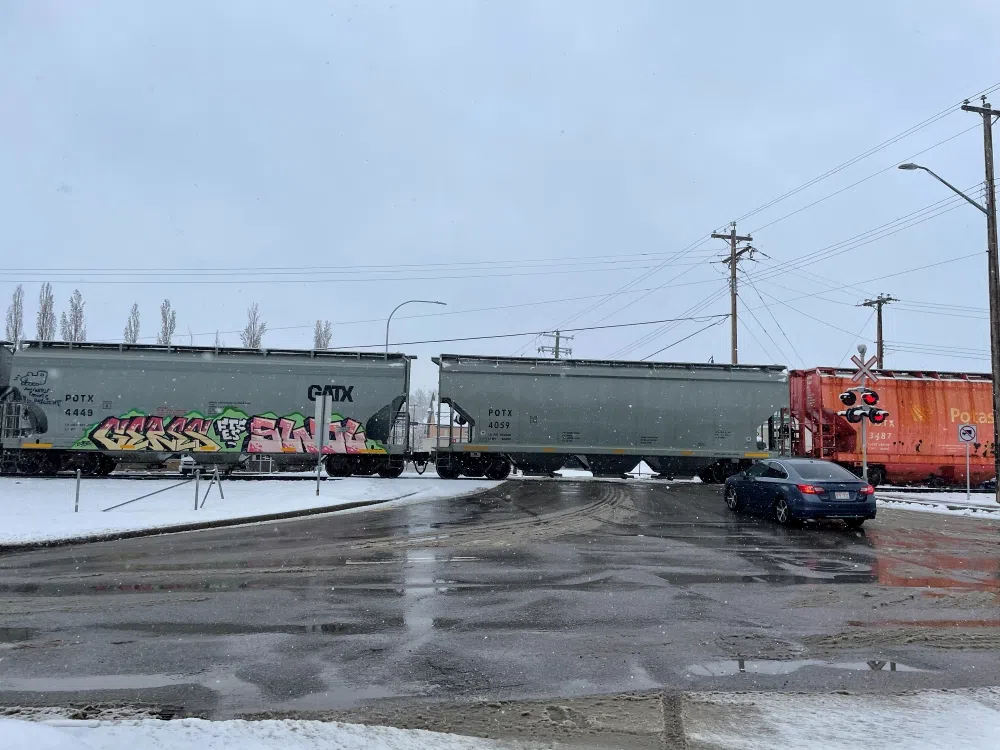
A report found the cause of a train derailment in 2024. Photo by Stephen Strand
The Transportation Safety Board of Canada (TSB) released an investigation report into a main-track derailment near Brooks that occurred in 2024.
On February 5, 2024, a Canadian Pacific Railway (CPKC) freight train was heading westward on the Brooks Subdivision, when a train-initiated emergency brake application occurred.
Following an investigation, it was found that the trailing head-end locomotive had derailed, as well as the first 17 intermodal rail cars.
No injuries were reported and no dangerous goods were released.
This investigation determined that the train had to be stopped in Ontario the day prior as a result of smoke emanating from one of the trailing head-end locomotive’s traction motors.
Following consultation with the supervisor mechanical locomotive (SML), the locomotive engineer cut out the affected traction motor and the axle’s speed sensor.
The locomotive engineer was then instructed to monitor the issue, and they then continued on their trip.
However, when they were recording the traction motor issues, neither the locomotive engineer or the SML made mention of the speed sensors in their respective fault logs.
The following day, and after several crew changes, the axle seized with the resulting damage to the wheel set causing a track failure and the subsequent derailment.
The investigation into the incident also found that cutting out the speed sensor removed an important line of defence, which protects against locked axle conditions.
According to the investigation report, neither the locomotive engineer or the SML fully understood the implications of this action, and the SML was still completing training modules and had not yet received training on the mechanical aspects of locomotives, which covers essential information for troubleshooting.
Without that technical knowledge, the SML was not aware of the potential consequences of cutting out speed sensors.
On top of that, in 2014-2015, CPKC had eliminated the central locomotive specialist position, which required in-depth knowledge of all major locomotive systems, as well as years of hands-on troubleshooting and repair experience.
Once that role was eliminated, the SMLs assumed many of the responsibilities, even though their role is broader.
“When specialist duties are transferred to a position occupied by an individual that is not specialized in those duties, unless technical training, mentoring, and operational experience are provided to bridge the gaps between the two positions, there is an increased risk that these duties will not be performed to meet safe railway operations,” the Investigation Report stated. “Following the occurrence, CPKC issued a bulletin to all locomotive facilities explaining the critical role of traction motor speed sensors. The bulletin further indicated that traction motor speed sensors can only be disabled in specific cases.”
CPKC has also implemented a Mechanical Locomotive Support desk, which has a dedicated five-person team of operations support coordinators and has taken over the locomotive troubleshooting responsibilities from SMLs.
To check out the full report, click here.
Comments