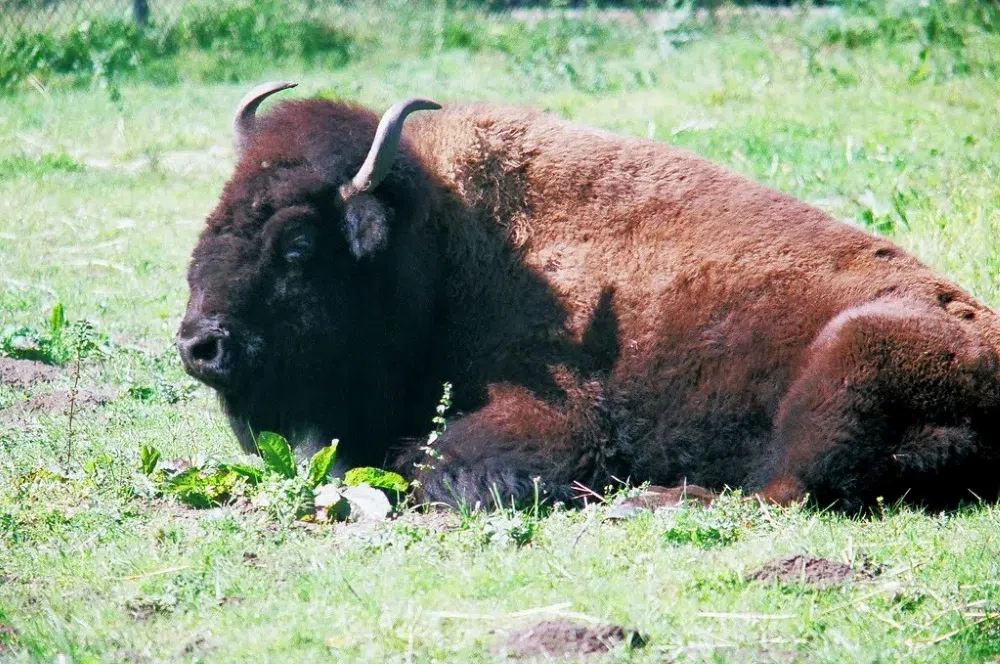
Elk Island National Park was not initially meant to host bison. Michael Fraley / CC
Elk Island National Park was not initially intended to be home to a bison herd.
When it was originally founded, it was an elk preserve, designed to protect one of the last big elk herds in the area, after five Albertans from the Fort Saskatchewan area persuaded the Canadian government to create a wildlife sanctuary for elk of the Beaver Hills.
The Beaver Hills were an important centre for commercial hunting, which helped to supply the fur trade.
The beaver, though, were virtually eliminated from the Beaver Hills by the 1830’s, thanks to the hunting.
In the Beaver Hills, bison were still being obtained in large quantities as late as 1841, and were quickly being depleted.
Then, by the late 1860’s, the number of large ungulates (mammals characterized by their hooved feet) were depleted to the point where the bison were almost completely gone, and other large herbivores were very scarce.
From the 1870’s through the homestead period, the lands in the Beaver Hills remained untouched, and the remaining forest resources were seen by some as a valuable timber resource and as a hinderance to settlement by others.
In 1895, a fire devastated the area, which prompted the federal government to protect the forest.
In 1899, the area officially became designated as ‘The Cooking Lake Forest Reserve.’
While the forest was protected, elk and mule deer were not, and sport hunting and hunting for meat by the settlers posed a threat to their population.
The elk that were present in the Beaver Hills were considered to be one of the last herds in Canada.
Then, the federal government created the new Dominion Forest Reserve Act, which established ‘Elk Park’ in July of 1906. And a 2.2 metre fence was constructed around the area, which included present day Astotin Lake.
Charlotte Brown, Ecologist with Parks Canada at Elk Island National Park, explains more.
Once created, Elk Park was the first wildlife refuge in Canada.
At the time, Elk Park was 42 square km, had a herd of 24 elk, 2 to 3 moose, and 35 mule deer, creating the foundation of today’s main park population.
In 1907, the Canadian Government purchased one of the last and largest remaining plains bison herds.
As a result, hundreds of bison from the Pablo-Allard herd of Montana were shipped to Elk Island, where they were planning on being held prior to being sent to Buffalo National Park near Wainwright, Alberta.
In 1908, Elk Park became known as Elk Island Park, and in 1909, approximately forty bison remained in Elk Island when the Pablo-Allard herd was transferred to Buffalo National Park.
Bison from the current herd at Elk Island Park are the descendants of those Bison left behind.
Then, in 1912, the last shipment of the Pablo-Allard bison herd arrived at Elk Island by train, and in 1913, Elk Island Park was designated as a Dominion Park.
From the 1920’s to the 1960’s, Bison robes from the herd at Elk Island were worn by RCMP members as winter coats.
During the Great Depression, unemployed men in labour relief camps built infrastructure in many Canadian National Parks, and at Elk Island National Park, they cleared land, built roads, and constructed the boundary fence along the park’s various building.
In 1936, a golf course was built in Elk Island National Park, making it one of the oldest golf courses in the province.
Between 1942 and 1946, the park’s superintendent, B.I. Love, who was also a veterinarian, initiated testing and translocating disease-free bison, and during this time, the first round up of 12,000 plains bison were tested for tuberculosis.
Also in 1942, beavers were reintroduced to the park, and the population grew rapidly.
Currently, there are upwards of 350 active beaver lodges in Elk Island.
In 1947, Elk Island National Park expanded to include 60 sq km south of Highway 16, and is now known as the Wood Bison Area.
After they introduced the Wood bison, they decided to keep them separated.
Wood Bison and Plains are two subspecies of the American Bison.
Brown explains the differences.
The bison herds at Elk Island were declared disease-free and free of cattle genes in 1972, and in 1988, Wood bison were down-listed from rare to threatened species.
In 2006, the Beaver Hills Dark Sky Preserve was designated by the Royal Astronomical Society of Canada, which also encompasses Elk Island National Park, and the neighbouring protected areas.
Then, in 2016, the Beaver Hills area, including Elk Island National Park, was designated a UNESCO Biosphere Reserve, and is recognized globally for its commitment to conservation and sustainable development.
It was also in 2016 that 87 plains bison, who are descendants of the Pablo-Allard Montana herd, were relocated to the Blackfeet Nation Reservation in Montana, which is these bison’s ancestral home.
According to Brown, the herd at Elk Island National Park has grown over the years, and there are currently hundreds of Bison roaming the Park.
The bison at Elk Island are primarily self-sufficient.
The bison from Elk Island National Park have also played an important role in growing herds elsewhere.
After being gone from the wild in Banff for over 100 years, 16 plains bison were successfully relocated from Elk Island National Park to the Panther Valley in Banff National Park in 2017.
It was the plains bison that were in the Banff area originally.
There will be more bison transfers this year.
On Earth Day, April 22, 2018, a bison calf was born in Banff National Park, which was the first bison calf born from the Elk Island herd in the area.
Also in 2018, the bison herd was released from pasture in July, and were free to cross the rivers and roam the valleys of Banff National Park.
According to Dillon Watt, Bison Reintroduction Project Manager for Banff National Park, the number of bison in Banff National Park has now grown.
Watt says the bison in Banff National Park are thriving, as they are able to get everything they need year-round.
Not only that, but they have spread out into different groups, using different patches of habitat throughout the National Park.
Like the bison in Elk Island National Park, the bison in Banff National Park are completely wild, free-roaming animals that find the resources they need on their own.
According to Watt, there were a couple different objectives of this transfer project.
Even though they are still in the early stages of having free-ranging bison in Banff National Park, they are monitoring and researching the effects the bison are having on the ecosystem around them.
Things like changes in the vegetation, changes in their interactions with other animals, and the potential changes that could affect songbirds.
On top of the bison transfer to Banff, Charlotte Brown says that a lot of the current bison in Canada originated from Elk Island National Park.
To learn more about Elk Island National Park, click here.
To learn about a piece of history that is moving to Elks Island National Park, click here.
To read about an old buffalo jump in Southern Alberta, click here.
Comments