Calgary’s relationship with its NHL team and the building it plays in will soon change.
The Flames open their final season at the Saddledome on Oct. 1 after 43 years.
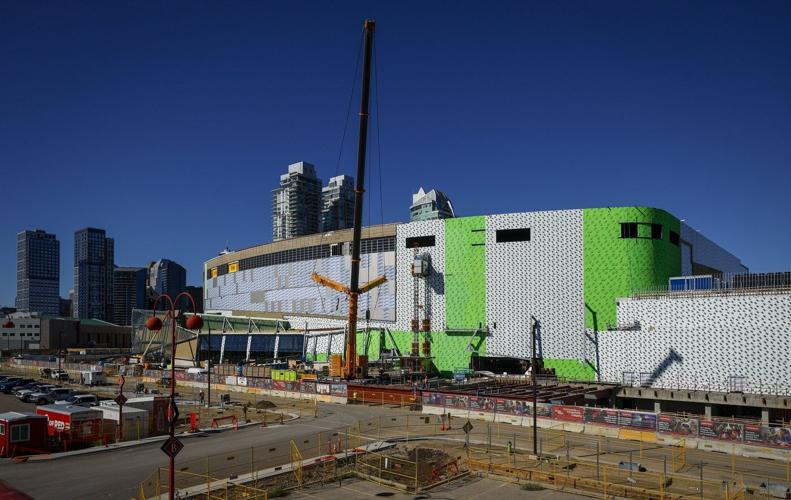
The team will move across the street to Scotia Place next year.
“It’s emotional for people,” Hayes said. “It’s emotional in that we’re going to leave this building . . . and moving into a really cool new place. I think there will be new emotions as you go into a new building.”
Work continues on the new structure with its 7,760-tonne steel frame completed in early September.
CSEC is the second-largest investor in the $1.2-billion Scotia Place after the city, and will continue as prime tenant with three hockey teams and a lacrosse team.
Scotia Place will feature an 18,400-seat hockey arena expandable to 20,000 for concerts, a 1,000-seat community arena, indoor and outdoor community plazas and a parkade.
The city committed $537 million, CSEC $356 million and the province $330 million to the project.
CSEC will operate Scotia Place and take in all revenue while paying the city $17 million annually, plus a one-per-cent increase each year, over a 35-year lease.
CSEC will begin shepherding the Flames, and their fans, out of the Saddledome by paying homage to the vintage arena and its history during games this winter.
Calgary has already been awarded co-host status of the 2028 World Cup of Hockey alongside Edmonton and Prague, but Hayes wants Calgarians to see Scotia Place’s potential beyond hockey.
“In the new building we’re going to be, from a North American perspective, No. 1 in what you can do in the building, what you can set up in the building,” he said. “It’s going to have a huge community impact.”
Concerts and shows requiring technology the Saddledome can’t accommodate as well as figure skating, basketball, volleyball, soccer and indoor track and field are among Scotia Place’s non-hockey options, he said.
“When we get into the immigration that’s happened in our city, because we’ve become incredibly diversified over the 24 years that I’ve lived here, what can we do to really tap into those different pockets that aren’t necessarily sports related, or sports related with what we have, lacrosse and the hockey? Maybe we do indoor soccer or something like that?” he said.
“Different types of sports and activities from that perspective, but what you can activate from a non-sport point of view, again, your imagination is the only thing that’s holding you back.”
The new building will have at-grade entrances and will be more accessible to people with mobility aids than the Saddledome with its many stairs, Hayes added.
The NHL team is CSEC’s lifeblood, however, and is expected to be the consistent draw for thousands of people to watch games at the new arena live, or in one of the four restaurants or the food hall in the design.
“I really truly think even that person who’s a non-sports fan, when they come down, when they see this facility, see the area, are going to be blown away by what they see,” Hayes said.
When it became clear the Flames would miss the playoffs a fourth straight year midway through last season, the team embarked on a pronounced youth movement and rebuild.
“Winning team, that makes everybody a lot happier and from my perspective, it drives ticket sales and those sorts of things going into the new building,” Hayes said. “People have told me ‘you’re going to have a honeymoon period because everybody wants to see the new building’ but again, you have to have a team that’s competitive and going in the right direction.
“(General manager) Craig Conroy and his management team have done an amazing job in that regard so I think we have a pretty bright future from a hockey point of view.”
Comments