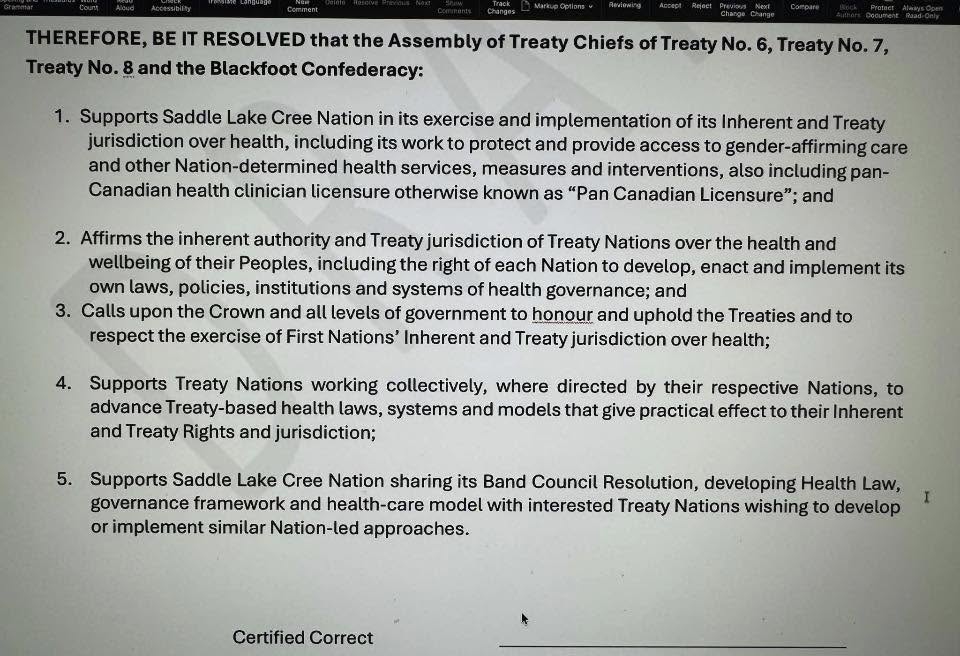
Indigenous leaders from Treaties 6, 7, and 8, joined by the Blackfoot Confederacy, have passed an urgent resolution backing Saddle Lake Cree Nation’s decision to use its Treaty authority to offer refuge for individuals seeking gender-affirming medical care.
In a news release, Saddle Lake emphasized that this endorsement from fellow Treaty Nations underscores they are not isolated in the effort. By asserting jurisdiction in this way, the Nation noted, Treaty rights are reinforced for every participating community and for generations yet to come.
Last week the Nation revealed plans to draft its own legislation safeguarding health-care providers who deliver gender-affirming treatments restricted under Alberta’s current rules.
Officials pointed to language in Treaty 6 guaranteeing “that a medicine chest shall be kept at the house of each Indian Agent for the use and benefit of the Indians” as the foundation for the initiative.
“This is what it means for Treaty to be alive — exercising the promises our ancestors made to protect all of our children, families, and future generations,” Chief Dale Steinhauer of the Saddle Lake Cree Nation said in a news release. “Our definition of protection is very different than Premier Smith’s understanding of what protection is. Protection should not harm.”
Alongside the protective law, Saddle Lake is developing a national clinician-licensing pathway. The system would enable qualified Canadian health professionals to serve the Nation without first navigating provincial credentialing hurdles.
Leaders described the change as a major step toward expanding access to doctors and other practitioners—resources First Nations have long struggled to attract and keep under the present colonial framework.
According to the Nation, multiple physicians and health workers from across Canada have already shown interest and contacted the College of Physicians and Surgeons of Alberta about obtaining licenses.
Saddle Lake plans to apply the same model not only to gender-affirming care but also to primary care, specialist services, and the full range of allied health professions.
The Nation has pledged to share both its forthcoming health-law governance structure and the broader care-delivery model with any other Treaty Nations that wish to adopt similar approaches.
Comments