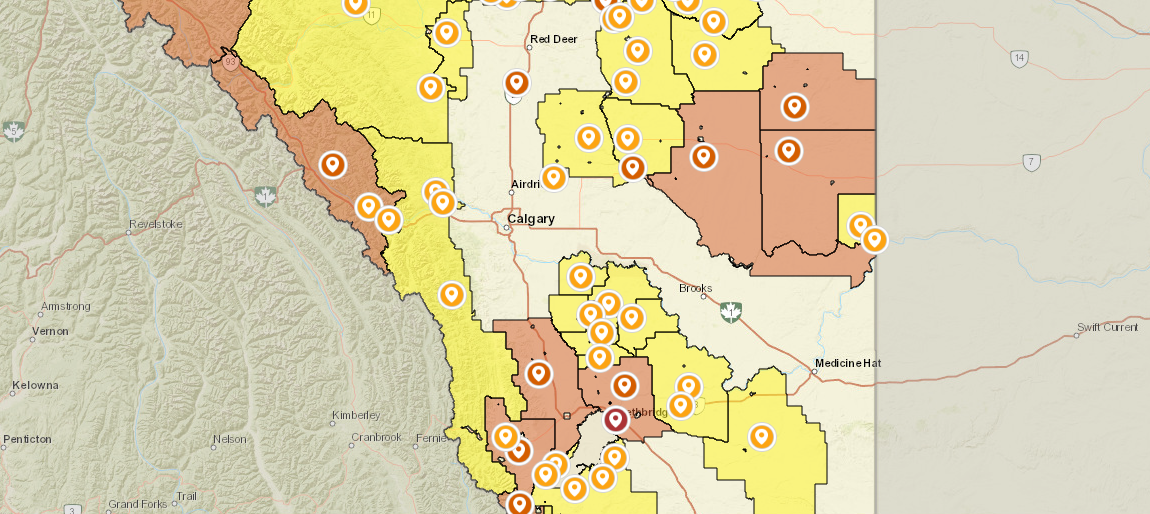
November 9th and 10th both had multiple fire bans and restrictions enacted, as dry weather, unseasonably warm temperatures, and high winds are causing some southern Alberta areas to re-enact fire bans, restrictions, and advisories.
The conditions are likely the result of the current, unusually powerful El Niño weather pattern. A recent report from The World Meteorological Organization, or WMO shows that the global average surface temperature from January to September was more than 2.5 degrees Fahrenheit more than the 1850-1900 pre-industrial average. According to the WMO, 2023 to 2026 currently hold the top four hottest years on record.
Back in late May of this year, CJWE sat down with Dr. Bill Merryfield, Research Scientist and Climate Research Directorate, and got some details about the Super El Niño and it’s potential effects on southern Albertans.
Read more on that story here.
No warning areas:
Calgary and Red Deer currently do not have any restrictions, bans or advisories active, with the exception of Innisfail, who has a blanket fire restriction active. Brooks and Medicine Hat are both advisory free as well, at the time of this article.
Advisories:
The Calgary Forest Area is asking people to not burn anything if the wind conditions are more than 15 km/h. Vulcan County is under a fire advisory as of September 9th,and has recently switched from restrictions to an advisory. The Municipal District of Taber has a fire advisory active, and urges anyone doing a controlled burn to exercise “extreme caution” due to hot and dry conditions in the area.
Canmore and the MD of Bighorn have also issued advisories due to dry conditions, as of November 9th. Residents are asked to exercise caution during fire burning, and not to do any burns when the wind is above 15 km/h.
Cardston County and the Town of Magrath both have advisories that say to only use designated campfire pits, and burning of yard or construction material is prohibited. The villages of Glenwood and Hill Spring also have advisories active.
Current and active restrictions:
Banff National Park remains under a fire restriction, with fires limited to designated Parks Canada metal fire rings or boxes. A rock ring, or random fires are not allowed during the restriction. Due to hot temperatures and a lack of precipitation, as well as recent strong winds, a new fire restriction in the Municipal District of Willow Creek has been enacted as of November 9th. All Fire Permits in the area have been suspended, and will be reissued when a “significant amount of moisture is received.”.
The Piikani Nation and the MD of Pincher Creek announced a fire restriction today due to dry, warm and windy conditions, as well as the current state of the cured grassland. As of today, no fires outside permitted fire pits will be allowed, and no debris burn permits will be issued at this time. Fireworks will also be prohibited.
Waterton Lakes has been under a fire restriction since July 29th of this year, and just like Banff, only Parks Canada metal rings or fire boxes are permitted for fires.
Lethbridge County enacted their own fire restrictions on November 9th as well, citing high sustained temperatures and a lack of moisture. All active burns, as well as fireworks are now prohibited, and recreational fire pits must meet the specifications of the Lethbridge County Fire Bylaw (click here). The details on the City of Lethbridge’s fire ban can be found below.
The Special Areas Board near Hanna, Alberta is also under fire restrictions.
Fire Bans:
As of now, only one area in southern Alberta has enacted a full fire ban. The City of Lethbridge announced yesterday that a fire ban would be enacted, meaning all open fires will be prohibited. The City is citing sustained warm temperatures, as well as high winds are creating conditions where even a small spark could create a fast moving, uncontrollable fire.
Comments